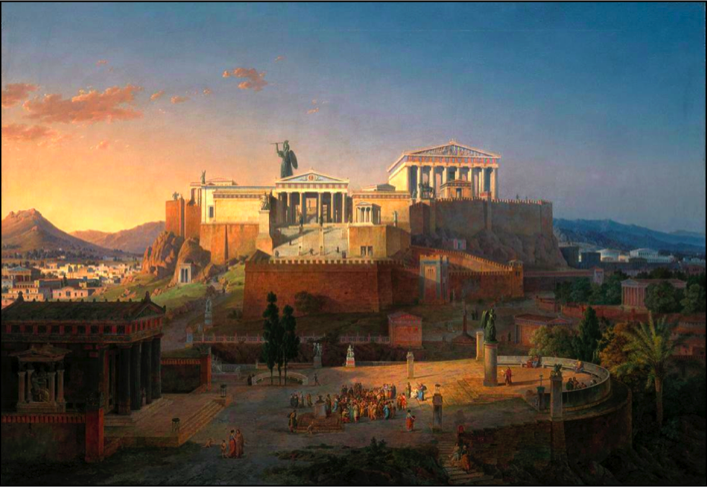
On the Acropolis of ancient Athens stood the Parthenon, a glorious temple to a woman we commonly call Athena. Outside her temple stood a huge bronze statue of her in warrior mode.
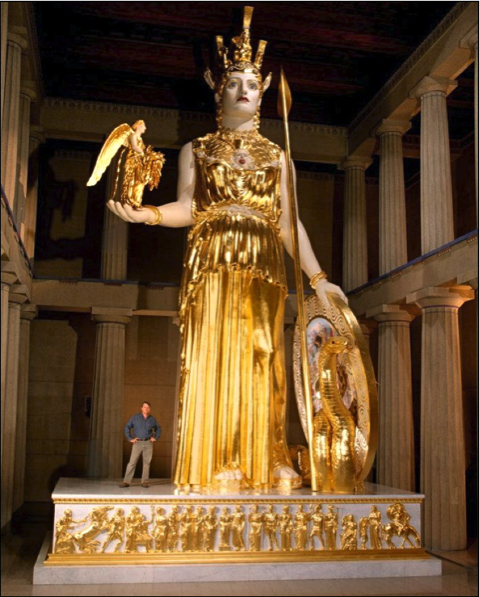
Inside her temple stood her 40-foot-tall gold and ivory idol-image. In here right hand, she holds Nike, or Victory. By her left side, the golden Genesis serpent rises up next to her. This is the woman whose friendship with the serpent has led to humanity's victory over Noah and his God-fearing offspring in the post-Flood world. Alan LeQuire, who reconstructed her idol-image inside the imitation Parthenon in Nashville, Tennessee, stands besider her, giving us an idea of the immense adoration the ancient Greeks had for this woman.
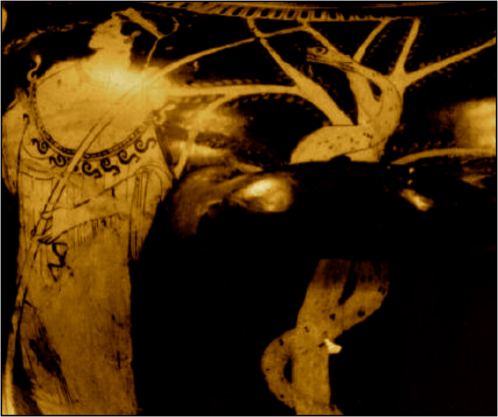
In this rare and revealing vase-painting from 450 BC, Athena, identified by her serpent-trimmed aegis, stands proudly next to the serpent-entwined apple tree. (The vase handle obscures part of the tree and serpent). The serpent appears to be giving her instructions: it has her ear, as it had Eve’s ear in the ancient garden. Athena welcomes the serpent’s “enlightenment.”
Ancient Greek artists communicated in a universal language that we can understand—once we see that the early events and people described in the Book of Genesis hold the interpretive key to that understanding.
Athena is one of many ancestors in Genesis worshipped as a god or goddess. All of them are significant, but as we shall see, she is the central figure. Without her, there is no coherent story to tell.
Athena is not her name; it is her title. In the most ancient Greek writing referred to as Linear B, her title first appears as Athana. The word thanatos in ancient Greek means death. A-thanatos signifies deathlessness. Athana is a shortened form of Athanatos, meaning the immortal one.
The “immortal” woman, Athana, over time Athena, is a glorification of the real princess from the line of Cain named Naamah in Hebrew and Chariklo in Greek. She is the last person mentioned in Cain’s line before the Flood—“And the sister of Tubal-Cain is Naamah” (Genesis 4:22). As we shall see from the evidence of ancient Greek art, Noah’s son, Ham, took her, married her, and brought her through the Flood aboard the ark.
We shall see that Greek art boasts of the triumph of the way Cain after the Flood—inspired by Naamah/Athena and carried out by her son Cush/Hermes and her grandson, Nimrod/Herakles. We will meet her other relatives who are also portrayed in Greek art: the first human couple, Adam/Zeus and Eve/Hera from the ancient garden with the serpent-entwined apple tree, her ancestor Cain/Hephaistos, her father, Lamech/Atlas who ruled the pre-Flood Cainite world, her husband Ham/Chiron whom she abandoned after the Flood, and her father-in-law, Noah/Nereus whose God-centered rule she usurped in favor of a return to the serpent’s “wisdom” and the exaltation of man as the measure of all things.
I am pleased to present to you this pictorial history of the human race, painted and sculpted two and a half millennia ago by artists who knew their subjects—their ancestors and the key events of their history—far better than we have previously realized.
To paraphrase Paul in Galations 6:10, I offer this work as a benefit to all, yet especially to the family of faith.
Robert Bowie Johnson, Jr.
THE MEMORY OF THE ADORED WOMAN