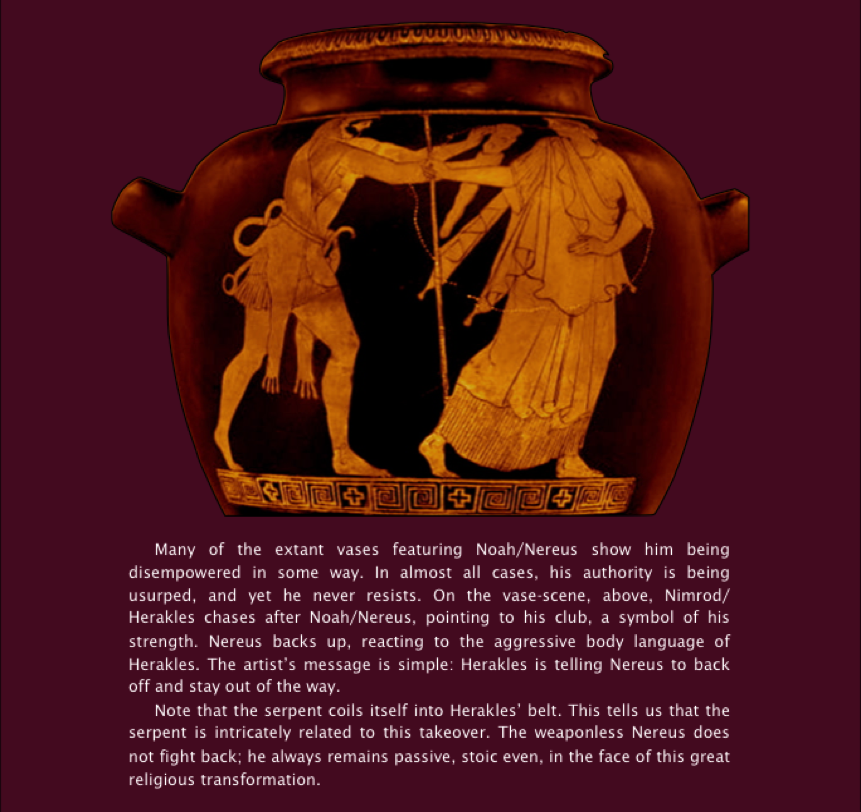
Many of the extant vases featuring Noah/Nereus show him being disempowered in some way. In almost all cases, his authority is being usurped, and yet he never resists. On the vase-scene, Nimrod/Herakles chases after Noah/Nereus, pointing to his club, a symbol of his strength. Nereus backs up, reacting to the aggressive body language of Herakles. The artist's message is simple: Herakles is telling Nereus to back off and stay out of the way.
Note that the serpent coils itself into Herakles' belt. This tells us that the serpent is intricately related to this takeover. The weaponless Nereus does not fight back; he always remains passive, stoic even, in the face of this great religious transformation.
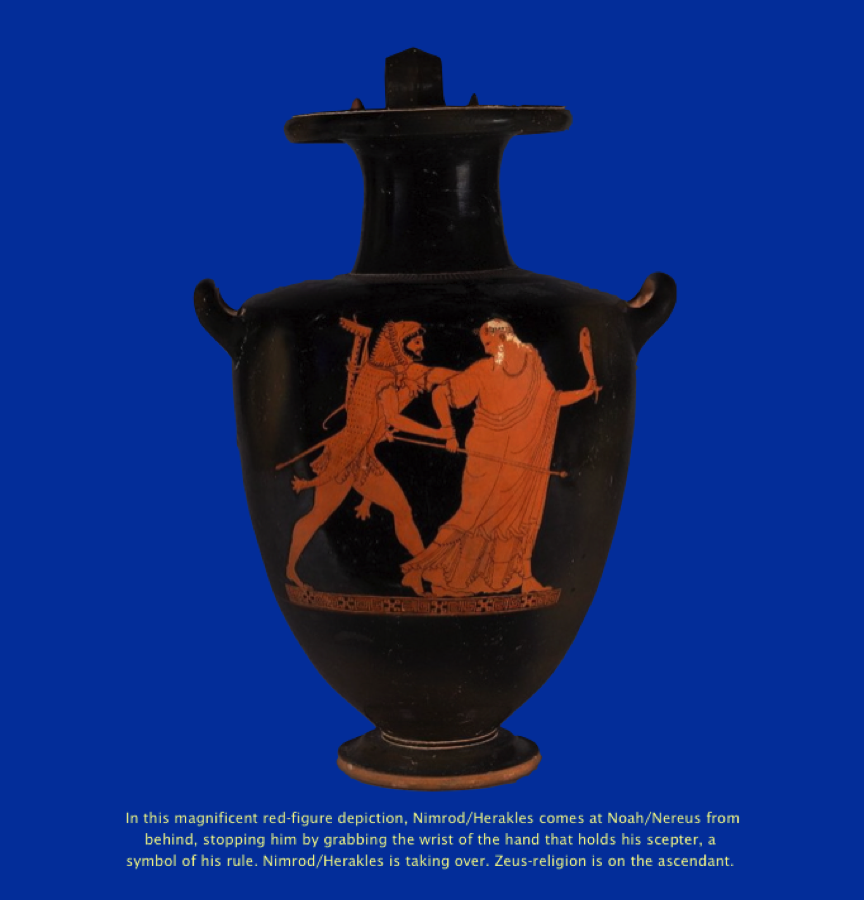
In this magnificent red-figure depiction, Nimrod/Herakles comes at Noah/Nereus from the rear, stopping him by grabbing the wrist that holds his scepter, a symbol of his rule. Nimrod/Herakles is taking over. Zeus-religion is on the ascendant.
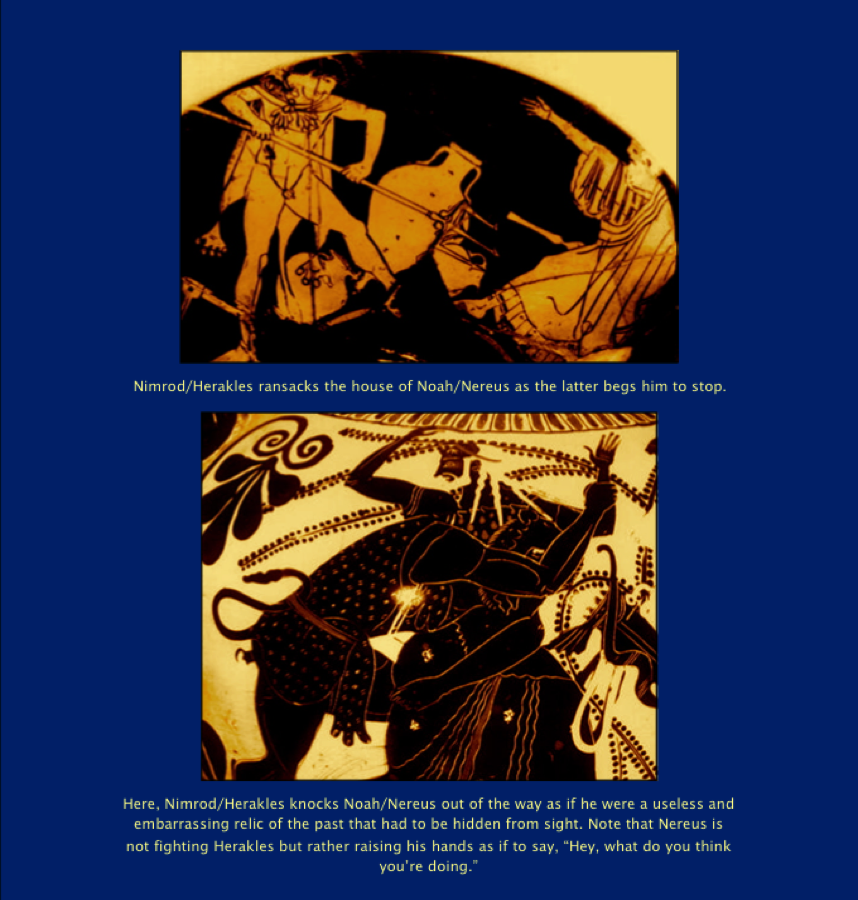
Here, Nimrod/Herakles knocks Noah/Nereus out of the way as if he were a useless and embarrassing relic of the past that had to be hidden from sight. Note that Nereus is not fighting Herakles but rather raising his hands as if to say, “Hey, what do you think you’re doing?”
Nimrod/Herakles ransacks the house of Nereus/Noah as the latter begs him to stop.
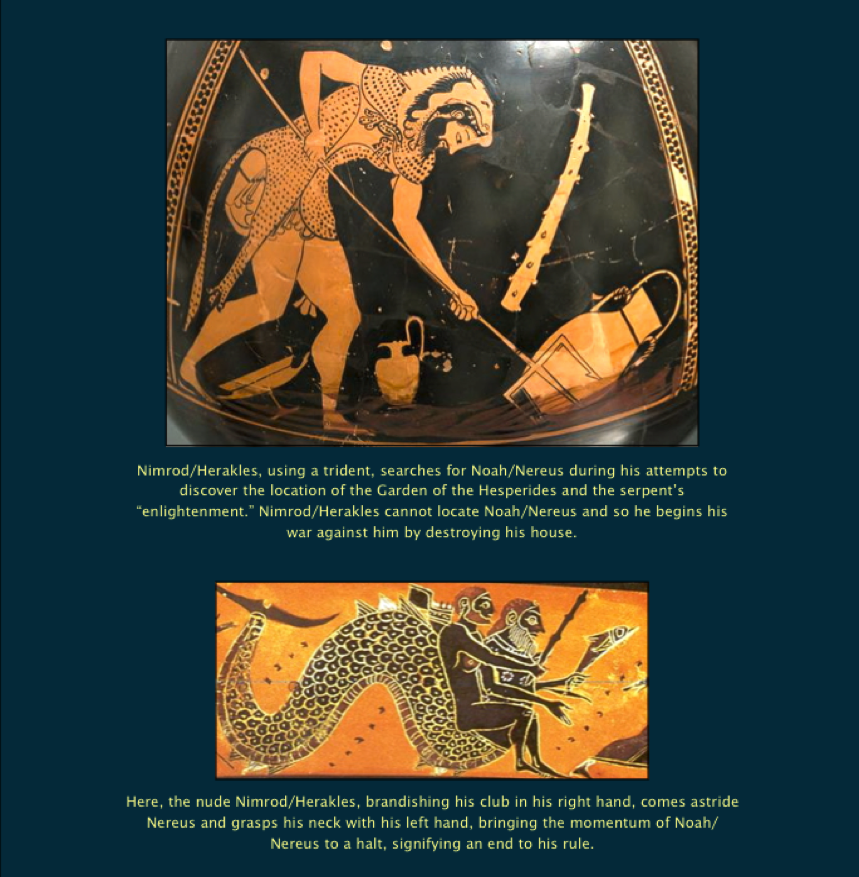
Here, the nude Nimrod/Herakles, brandishing his club in his right hand, comes astride Nereus and grasps his neck with his left hand, bringing the momentum of Noah/Nereus to a halt, signifying an end to his rule.
Nimrod/Herakles, using a trident, searches for Noah/Nereus during his attempts to discover the location of the Garden of the Hesperides and the serpent’s “enlightenment.” Nimrod/Herakles cannot locate Noah/Nereus and so he begins his war against him by destroying his house.
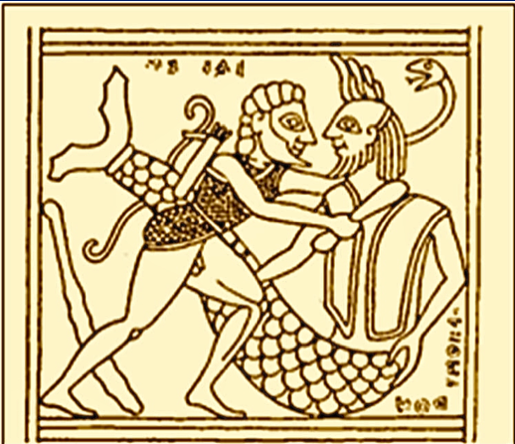
For a number of years after the Flood, God’s awesome and decisive intervention in human affairs remained fresh in the minds of Noah’s descendants, and the way of Cain remained dormant. Then, gradually, inspired by Naamah/Athena, a yearning for the serpent’s “enlightenment” began to take hold. On the shield band panel, above, from about 550 BC, a Greek artist depicted this all-too-human desire perfectly.
The characters are the great hero, Herakles, the Nimrod of Genesis transported to Greek soil, and Nereus, the Greek Noah. Nereus, the “Wet One,” has the bottom half of a fish, signifying that he came through the Flood. The inscription on this panel refers to him as Halios Geron—“The Salt Sea Old Man.” Nimrod/Herakles demands to know something he believes only the Salt Sea Old Man can tell him. A flame and a serpent come out of Nereus’ head. This tells us what Herakles is after—the “enlightenment” of the Genesis serpent. Herakles insists that Noah/Nereus tell him where he can find the Garden of the Hesperides with its ancient serpent-entwined apple tree symbolizing that “enlightenment.”
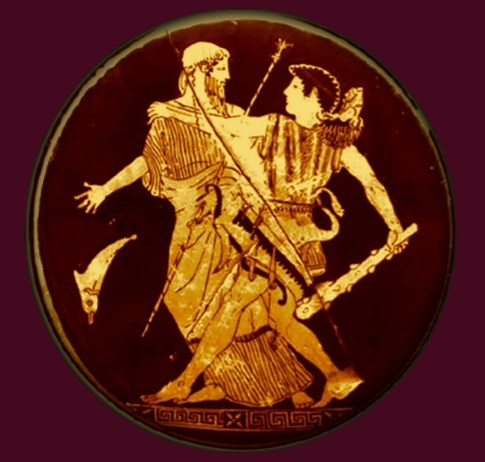
This red-figure bobbin (a spool used in weaving), depicts Nimrod/Herakles knocking Noah/Nereus out of the way, negating his authority and replacing it with his own. On this depiction and the one that follows, the artists associate Noah/Nereus with a fish, connecting him to the Flood, distinguishing him from just any old man.